INTRODUCTION

Among the photosensitive devices
in use today, the photomultiplier tube (or PMT) is a versatile device that
provides extremely high sensitivity and ultra-fast response. A typical
photomultiplier tube consists of a photoemissive cathode (photocathode) followed
by focusing electrodes, an electron multiplier and an electron collector (anode) in
a vacuum tube.When light enters the photocathode, the
photocathode emits photoelectrons into the vacuum. These photoelectrons are
then directed by the focusing electrode voltages towards the electron multiplier
where electrons are multiplied by the process of secondary emission. The multiplied
electrons are collected by the anode as an output signal. Because of
secondary-emission multiplication, photomultiplier tubes provide extremely high
sensitivity and exceptionally low noise among the photosensitive devices
currently used to detect radiant energy in the ultraviolet, visible, and near
infrared regions. The photomultiplier tube also features fast time response, low
noise and a choice of large photosensitive areas.
HISTORY
In 1935, Iams succeeded in producing a triode
photomultiplier tube with a photocathode combined with a single-stage dynode
(Secondary emissive surface), which was used for movie sound pickup. In the
next year 1936, Zworykin developed a
photomultiplier tube having multiple dynode stages. This tube enabled electrons
to travel in the tube by using an electric field and a magnetic field.Then, in
1939, Zworykin and Rajchman developed an electrostatic-focusing type
photomultiplier tube (this is the basic structure of photomultiplier tubes
currently used). In this photomultiplier tube, an Ag-O-Cs photocathode was
first used and later an Sb-Cs photocathode was employed.An improved
photomultiplier tube structure was developed and announced by Morton in 1949) and
in 1956. Since then the dynode structure has been intensively studied, leading
to the development of a variety of dynode structures including circular-cage,
linear-focused and box-and-grid types. In addition, photomultiplier tubes using
magnetic-focusing type multipliers transmission-mode secondary-emissive
surfaces and channel type multipliers have been developed.
CONSTRUCTION
A
photomultiplier tube is a vacuum tube consisting of an input window, a photocathode,
focusing electrodes, an electron multiplier and an anode usually sealed into an
evacuated glass tube. Figure shows the schematic construction of a
photomultiplier tube.
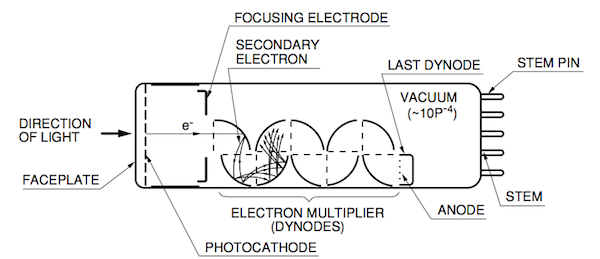
Light
which enters a photomultiplier tube is detected and produces an output signal
through the following processes.
(1)
Light passes through the input window.
(2)
Light excites the electrons in the photocathode so that photoelectrons are
emitted into the vacuum (external photoelectric effect).
(3)
Photoelectrons are accelerated and focused by the focusing electrode onto the
first dynode where they are multiplied by means of secondary electron emission.
This secondary emission is repeated at each of the successive dynodes.
(4)
The multiplied secondary electrons emitted from the last dynode are finally
collected by the anode.
The photomultiplier tube
generally has a photocathode in either a side-on or a head-on configuration.
The side-on type receives incident light through the side of the glass bulb,
while in the head-on type, it is received through the end of the glass bulb. In
general, the side-on type photomultiplier tube is relatively low priced and
widely used for spectrophotometers and general photometric systems. Most of the
side-on types employ an opaque photocathode (reflection-mode
photocathode) and a circular cage structure electron multiplier which has good
sensitivity and high amplification at a relatively low supply voltage.
The
head-on type (or the end-on type) has a semi transparent photocathode (transmission-mode
photocathode) deposited upon the inner surface of the entrance window.
The head-on type provides better
spatial uniformity than the side-on type having a reflection-mode photocathode.
Other features of head-on types include a choice of photosensitive areas from
tens of square millimetres to hundreds of square centimetres .
Variants of the head-on type
having a large-diameter hemispherical window have been developed for high
energy physics experiments where good angular light acceptability is important.
External appearance

Types of
Photocathode

WORKING
The superior sensitivity (high
current amplification and high S/N ratio) of photomultiplier tubes is due to
the use of a low-noise electron multiplier which amplifies electrons by a
cascade secondary electron emission process. The electron multiplier consists of
from 8, up to 19 stages of electrodes called dynodes.There are several
principal types in use today.
1)
Circular-cage type
The circular-cage is generally
used for the side-on type of photomultiplier tube. The prime features of the
circular-cage are compactness and fast time response.

2)
Box-and-grid type
This type consists of a train of
quarter cylindrical dynodes and is widely used in head-on type photomultiplier
tubes because of its relatively simple dynode design and improved uniformity,
although time response may be too slow in some applications.

3)
Linear-focused type
The linear-focused type features
extremely fast response time and is widely used in head-on type photomultiplier
tubes where time resolution and pulse linearity are important.

4) Venetian
blind type
The venetian blind type has a
large dynode area and is primarily used for tubes with large photocathode
areas. It offers better uniformity and a larger pulse output current. This structure
is usually used when time response is not a prime consideration.

5) Mesh type
The mesh type has a structure of
fine mesh electrodes stacked in close proximity. This type provides high
immunity to magnetic fields, as well as good uniformity and high pulse linearity.
In addition, it has position-sensitive capability when used with cross-wire
anodes or multiple anodes.

6)
Microchannel plate (MCP)
The MCP is a thin disk consisting
of millions of micro glass tubes (channels) fused in parallel with each other.
Each channel acts as an independent electron multiplier. The MCP offers much
faster time response than the other discrete dynodes.It also features good
immunity from magnetic fields and two-dimensional detection ability when
multiple anodes are used.

7) Metal
channel type
The Metal channel dynode has a
compact dynode costruction manufactured by our unique fine machining technique.It
achieves high speed response due to its narrower space between each stage of
dynodes than the other type of conventional dynode construction. It is also
adequate for position sensitive measurement.

PHOTOCATHODE
MATERIALS
The photocathode is a
photoemissive surface usually consisting of alkali metals with very low work
functions. The photocathode materials most commonly used in photomultiplier
tubes are as follows:
1)
Ag-O-Cs
The transmission-mode
photocathode using this material is designated S-1 and sensitive from the
visible to infrared range (300 to 1200nm). Since Ag-O-Cs has comparatively high
thermionic dark emission, tubes of this photocathode are mainly used for
detection in the near infrared region with the photocathode cooled.
2)
GaAs(Cs)
GaAs activated in
cesium is also used as a photocathode. The spectral response of this
photocathode usually covers a wider spectral response range than multi alkali,
from ultraviolet to 930nm, which is comparatively flat over 300 to 850nm.
3)
InGaAs(Cs)
This photocathode has
greater extended sensitivity in the infrared range than GaAs. Moreover, in the
range between 900 and 1000nm, InGaAs has much higher S/N ratio than Ag-O-Cs.
4)
Sb-Cs
This is a widely used
photocathode and has a spectral response in the ultraviolet to visible range.
This is not suited for transmission-mode photocathodes and mainly used for
reflection-mode photocathodes.
5)
Bialkali (Sb-Rb-Cs, Sb-K-Cs)
These have a spectral
response range similar to the Sb-Cs photocathode, but have higher sensitivity
and lower noise than Sb-Cs. The transmission mode bialkali photocathodes also
have a favorable blue sensitivity for scintillator flashes from NaI (Tl)
scintillators, thus are frequently used for radiation measurement using
scintillation counting.
6)
High temperature bialkali or low noise bialkali (Na-K-Sb)
This is particularly
useful at higher operating temperatures since it can withstand up to 175°C.
A major application is in the oil well logging industry. At room temperatures,
this photocathode operates with very low dark current, making it ideal for use
in photon counting applications.
7)
Multialkali (Na-K-Sb-Cs)
The multialkali
photocathode has a high, wide spectral response from the ultraviolet to near
infrared region. It is widely used for broad-band spectrophotometers. The long
wavelength response can be extended out to 930nm by special photocathode
processing.
8)
Cs-Te, Cs-I
These materials are
sensitive to vacuum UV and UV rays but not to visible light and are therefore
called solar blind. Cs-Te is quite insensitive to wavelengths longer than
320nm,and Cs-I to those longer than 200nm.
WINDOW
MATERIALS
The window materials
commonly used in photomultiplier tubes are as follows:
1)
Borosilicate glass
This is frequently
used glass material. It transmits radiation from the near infrared to
approximately 300nm. It is not suitable for detection in the ultraviolet
region. For some applications,the combination of a bialkali photocathode and a low-noise
borosilicate glass (so called K-free glass) is used.The K-free glass contains
very low potassium (K2O) which can cause background counts by 40K. In
particular, tubes designed for scintillation counting often employ K-free glass
not only for the faceplate but also for the side bulb to minimize noise pulses.
2)
UV-transmitting glass (UV glass)
This glass transmits
ultraviolet radiation well, as the name implies, and is widely used as a
borosilicate glass. For spectroscopy applications, UV glass is commonly used.
The UV cut-off is approximately 185nm.
3)
Synthetic silica
The synthetic silica
transmits ultraviolet radiation down to 160nm and offers lower absorption in
the ultraviolet range compared to fused silica. Since thermal expansion
coefficient of the synthetic silica is different from Kovar which is used for the
tube leads, it is not suitable for the stem material of the tube . Borosilicate
glass is used for
the stem, then a
graded seal using glasses with gradually different thermal expansion
coefficients are connected to the synthetic silica window. Because of this
structure, the graded seal is vulnerable to mechanical shock so that sufficient
care should be taken in handling the tube.
4)
MgF2 (magnesium fluoride)
The crystals of
alkali halide are superior in transmitting ultraviolet radiation, but have the
disadvantage of deliquescence. Among these, MgF2 is known as a practical window
material because it offers low deliquescence and transmits ultraviolet
radiation down to 115nm.
SCINTILLATION
COUNTING

Scintillation
counting is one of the most sensitive and effective methods for detecting
radiation. It uses a photomultiplier tube coupled to a transparent crystal
called scintillator which produces light by incidence of radiation.
In radiation measurements, there
are two parameters that should be measured. One is the energy of individual
particles and the other is the amount of particles. Radiation measurements should
determine these two parameters.
When radiation enters the
scintillator, it produce light flashes in response to each particle. The amount
of flash is proportional to the energy of the incident racliation. The photomultiplier
tube detects individual light flashes and provides the output pulses which contain information on both
the energy and amount of pulses, as shown in Figure . By analyzing these output
pulses using a multichannel analyzer (MCA), a pulse height distribution (PHD)
or energy spectrum is obtained, and the amount of incident particles at various
energy levels can be measured accurately.
Typical PHDs or
energy spectra when gamma rays (55Fe, 137Cs, 60Co) are detected by the
combination of an NaI(Tl) scintillator and a photomultiplier tube. For the PHD,it
is very important to have distinct peaks at each energy level.This is evaluated
as pulse height resolution (energy resolution)and is the most significant
characteristic in radiation particle measurements.
References :
1. Photomultipier tubes basics and application (third edition), HAMAMATSU
2. Photomultiplier tubes construction and operating characteristics,HAMAMATSU
1. Photomultipier tubes basics and application (third edition), HAMAMATSU
2. Photomultiplier tubes construction and operating characteristics,HAMAMATSU


